Ask ten European buyers what CE marking means and you will get ten versions of “it is the certificate that lets the board into the EU”. It is not a certificate, and the misunderstanding costs money in both directions: files get approved that should not be, and compliant suppliers get asked for paper that has never existed.
Under Regulation (EU) No 305/2011 — the Construction Products Regulation, CPR — CE marking is a declaration. The manufacturer states, on their own legal responsibility, what the product does against a fixed list of characteristics. The evidence behind that statement is an initial type test carried out by a notified laboratory, plus a factory production control system that keeps the product the same from batch to batch. Nobody certifies the declaration itself. That is the design, not a loophole.
So the useful question is never “do you have CE?” — every exporter says yes. It is: send the DoP and the type test report for the thickness I am buying, and tell me which AVCP system you are under. What follows is how to read the answer.
What the mark is, and what it is not
The CE mark itself carries almost no information. It is a pointer: it says a declaration of performance exists for this product, and that the declared values are being held constant. The substance sits in the DoP — the Declaration of Performance — a document of two to four pages that names the product type, the harmonised standard, the AVCP system, the laboratory and the numbers.
- Not a quality grade. A1 non-combustible is a declared value, not a ranking. Two A1 boards can sit in different flexural classes at different densities, and both are equally CE marked.
- Not an approval for your project. CE marking covers the product as placed on the market. It says nothing about whether your assembly, substrate, fixing pattern or cavity detail satisfies the building code on that site.
- Not factory certification. ISO 9001 is a management-system certificate. A supplier holding ISO 9001 and no DoP has no product declaration at all.
- Not optional. Where a harmonised standard covers the product, placing a fiber cement board on the EU market without a DoP and CE marking is not a marketing choice.
The chain, in the order it happens
| # | Step | Who is responsible |
|---|---|---|
| 1 | The CPR sets the obligation to declare performance for construction products | EU legislator |
| 2 | EN 12467, the harmonised standard for fibre-cement flat sheets, defines which characteristics are declared and how they are tested | CEN |
| 3 | The AVCP system named in the standard decides who tests and who supervises | Standard and CPR |
| 4 | Initial type testing (ITT) of the product family by a notified laboratory — under system 3, the only external test | Notified body |
| 5 | Factory production control (FPC): incoming material checks, mix control, curing records, calibration, non-conforming product | Manufacturer |
| 6 | DoP issued and signed, referencing the type test report and the standard | Manufacturer |
| 7 | CE mark affixed to product, label or packaging, with the DoP reference | Manufacturer |
Every link in that chain is checkable by a buyer in an afternoon. When a file feels thin, it is almost always because step 4 or step 5 is missing and step 6 was written anyway.
Which AVCP system applies, and why the word “certificate” keeps appearing
For fibre-cement flat sheets, assessment and verification of constancy of performance is normally system 3: a notified laboratory performs the initial type testing, the manufacturer runs factory production control, and there is no ongoing notified-body surveillance of the plant. Some characteristics, and some product families, sit in system 4, where no notified body is involved and the manufacturer's own type testing is the evidence.
The DoP states which system applies, and that one line tells you how much external verification stands behind the numbers. It also explains the vocabulary confusion: because a notified body issues the type test report, the trade started calling the whole thing “CE certification”, and the word certificate then migrated onto documents that are not certificates at all.
A practical test. A system 3 file names a notified body and a report number. If what arrives is a “CE certificate” from a consultancy, with no laboratory, no report number and no declared values, you have been shown step 7 without steps 4 to 6.
What the standard makes a manufacturer declare
EN 12467 does not ask a fiber cement board for a single headline number. It asks for a performance profile, and that profile is where the gap between a commodity sheet and a specified board becomes visible:
| Declared characteristic | What a usable DoP shows |
|---|---|
| Dimensions and tolerances | Length, width, thickness, squareness, flatness — thickness by product, not only as a range |
| Density | A figure in g/cm³, not the word “lightweight” |
| Flexural strength | A class designation plus the mean value |
| Water impermeability | Pass or fail against the standard's immersion test |
| Durability | Freeze–thaw and soak–dry sequences with retained strength |
| Reaction to fire | An EN 13501-1 class — A1 or A2 — with s and d sub-classes where relevant |
| Dangerous substances | A statement per REACH and CLP: the point where “asbestos-free” stops being a promise and becomes a document |
Read the version of the standard cited on the paper. EN 12467 has been amended more than once since 2012; a declaration written to a superseded edition is a conversation rather than an automatic rejection, but it is a question worth asking before the container is loaded.
A1 on paper, and what the test actually shows
A1 is not a marketing adjective. In the EN 13501-1 system it means the material is classified as non-combustible on the basis of test data, and for A1 that means both a non-combustibility test and a calorific potential test, with the s and d sub-classes covering smoke and burning droplets. Reaction to fire is the characteristic a DoP must declare for a board; how a supplier demonstrates it is often the clearest signal of how seriously the rest of the file was assembled.
Seven checks before you approve a CE file
- Who is the manufacturer on the paper? The DoP names a legal entity. If that entity is a trading company rather than a plant, ask for the producing site and its plant code — this is exactly where private-label supply gets complicated, and our OEM and private label guide sets out which documents stay with the factory no matter whose brand is on the pallet.
- Does the declared product type match what you are buying? Thickness, density, finish. A DoP covering a 4–25 mm family with type testing at one thickness is normal practice, provided the family is defined on the document. Our thickness selection guide covers which thicknesses a project actually needs declared.
- Is the standard version current? Compare the edition on the DoP with the version cited in the Official Journal of the EU.
- Is the fire class declared, and for which surface? A1 or A2 with sub-classes. Then ask the question in the next section: was the finish on the tested specimen?
- Is the notified body real? Look the four-digit number up in NANDO, the Commission's register of notified bodies, and check that its scope covers flat sheets. A number that does not resolve, or resolves to a body notified for a different product family, ends the review.
- Are dangerous substances declared? Asbestos, formaldehyde, substances of very high concern under REACH. For interior wall panel work this is often the clause a client's indoor-air consultant reads before anything else; our note on ENF and formaldehyde explains what the numbers mean.
- Is the DoP in the right language, and can it be kept? It must be supplied in the language or languages required by the member state where the product is placed on the market, electronic form is acceptable, and the manufacturer must hold the DoP and technical file for ten years after placing the product on the market.
Four traps that catch experienced buyers
1. A1 is a contribution to fire, not a fire rating
The most common misreading of a DoP is treating “A1” as if it meant “one hour”. It does not. A1 describes how a material contributes to a fire; one, two or three hours of fire resistance is a property of an assembly — board plus studs plus insulation plus fixings plus joints — established by a separate system test. A DoP will never give you a resistance period, and a supplier who quotes one from a DoP is quoting the wrong document. Our fire-rated partition guide shows how the 8 mm, 9 mm and 12 mm build-ups reach one, two and three hours respectively.
2. The finish is often not in the declaration
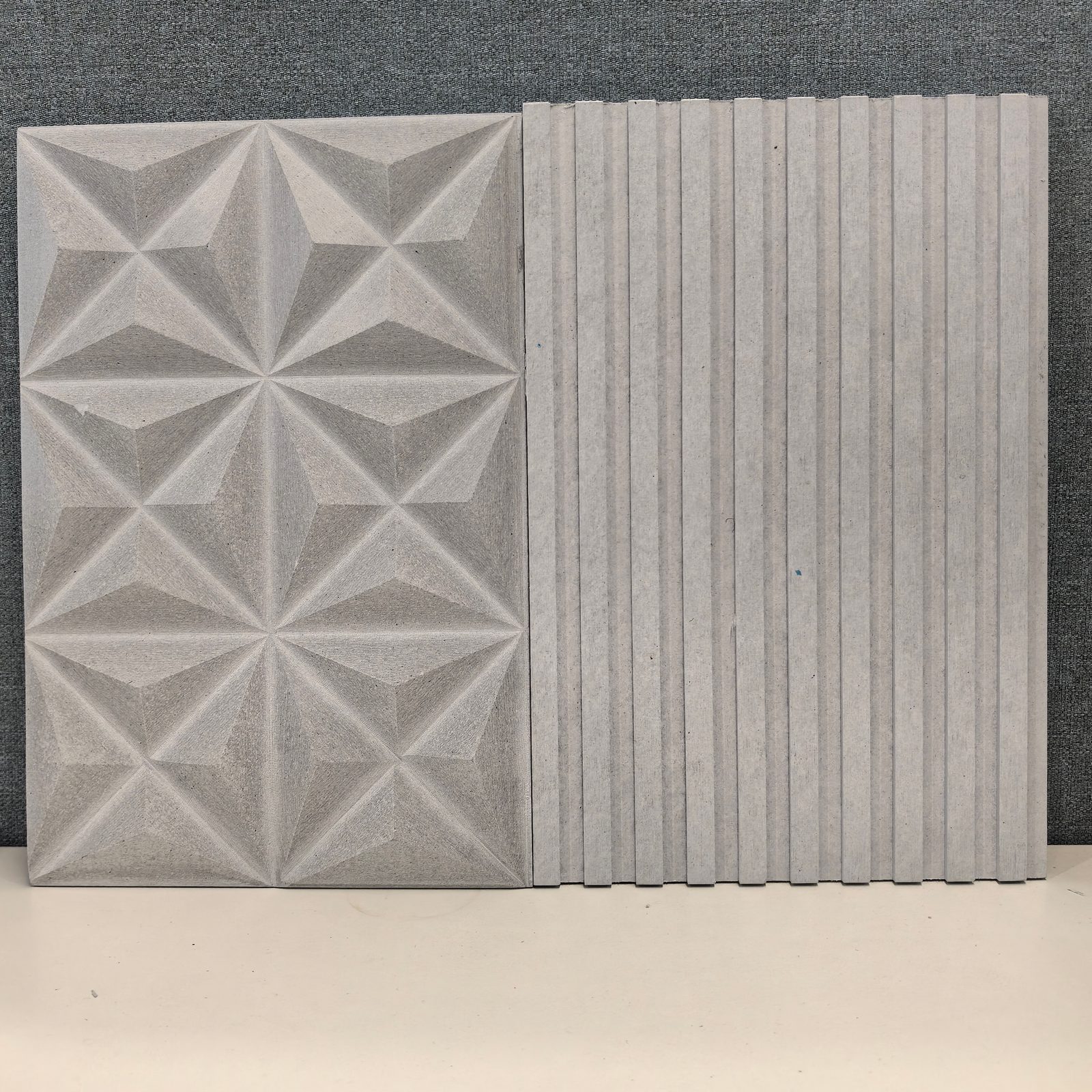
This is the trap that bites hardest on decorative board work. A decorative board with a factory-applied coating, a wood-grain print or a marble-look film is not automatically covered by the DoP of the bare sheet it was made from. A coating adds organic material to the surface, and that can move the reaction-to-fire classification and change the product type the type test was carried out on. When a proposal includes a coated wall panel rather than a raw board, ask for the DoP that names the coated product — not the one for the substrate underneath it. The same question applies to printed stone-look panels and carved 3D boards: the deeper the finish, the more the declaration needs to name it. For any decorative board carrying a print, a film or a deep carve, the declaration has to name the finished product type, not the sheet it started as.
The same logic runs through the calcium silicate board side of the range. Not every flat board is declared under EN 12467 — a calcium silicate board can be covered by a different harmonised specification depending on how it is sold and what it is sold for. Read the standard on the DoP, not the standard in the brochure.
3. A DoP is not an EPD
They get filed together and they answer different questions. The DoP declares performance — fire, strength, durability — under the CPR. An environmental product declaration reports life-cycle impacts under EN 15804, and it is what a green-building assessor usually wants. A supplier can be fully CE compliant and have no EPD; a supplier can have an EPD and a weak DoP. Neither document substitutes for the other, and a tender that asks for “environmental certification” without naming which one will collect the wrong paper from everybody.
4. CE marking stops at the EU border
Three things to keep separate. Great Britain runs its own regime alongside CE marking, and the recognition position for construction products has changed more than once — confirm the current rule before shipping rather than relying on a 2021 assumption. Switzerland is not in the EU: its building products ordinance requires a Swiss declaration of conformity, so an EU DoP is evidence, not the document itself. And inside the EU, member states add their own rules on top — facades above certain heights, fire compartments and escape routes are regulated nationally, not by the CPR. CE marking is the floor, not the ceiling.
What our own file contains
Listed plainly so it can be checked against the documents rather than taken on trust:
- Product families across the range — Crystal Board in both calcium silicate board and fiber cement board formulations, Coating Board, and Gorgeous Board for printed decorative board work
- Reaction to fire EN 13501-1 A1 (non-combustible) and A2 across the range, with AQ1 smoke toxicity on the interior products
- CE marking with DoP for flat sheets to BS EN 12467; ASTM C1288 for interior substrate sheets
- French A+ indoor air quality rating; REACH and CLP declarations; asbestos-free by composition, not by exemption
- ISO 9001:2015, ISO 14001:2015 and ISO 45001 — management systems, listed separately from the product declaration because they are a different thing
- CNAS-certified laboratory with 300+ pieces of test equipment, across three production bases and eleven lines
- Declared performance for the standard range: density 0.65–0.85 g/cm³, flexural strength ≥10 MPa, screw holding ≥1200 N, 100 freeze–thaw cycles to EN 12467 with ≥80% strength retained, wet expansion ≤0.25%
Full company and product figures are on the factory facts page, and the wider certificate set is explained in our guide to ASTM C1186 and EN 12467 certificates and the A1/A2 and green certification note. If you are comparing suppliers on documentation rather than price, the supplier sourcing checklist is the companion piece.
Ask for these four documents, in this order
- The DoP for the exact product type and thickness you are buying
- The initial type test report it references, with the laboratory's notified body number
- The reaction-to-fire classification report, naming the finish tested
- The FPC certificate or audit record for the producing plant
A CE mark tells you a declaration exists. The declaration tells you what the board does. Only the type test tells you whether anyone outside the factory ever checked.
Conclusion
Compliance files fail for boring reasons: a DoP that covers the bare board while the order is a coated wall panel, a fire class quoted as a fire rating, an ISO certificate standing in for a product declaration, a standard edition three amendments out of date. None of it is exotic and all of it is visible in an afternoon if you know which four documents to ask for.
For a fiber cement board, the sequence is short: standard, system, test, declaration, mark. Read it in that order and the CE logo stops being a badge and becomes what the regulation intended — a claim you can check.