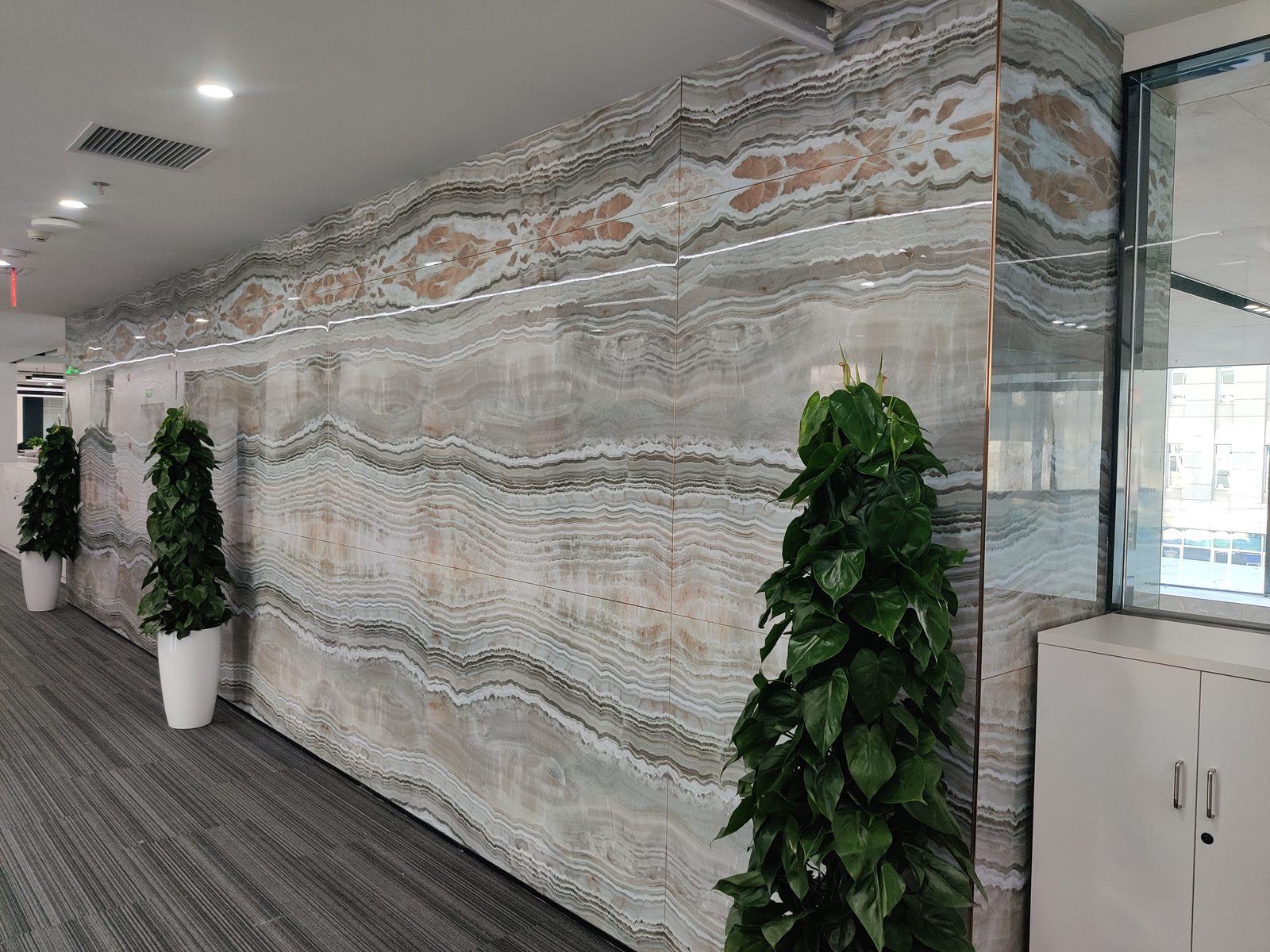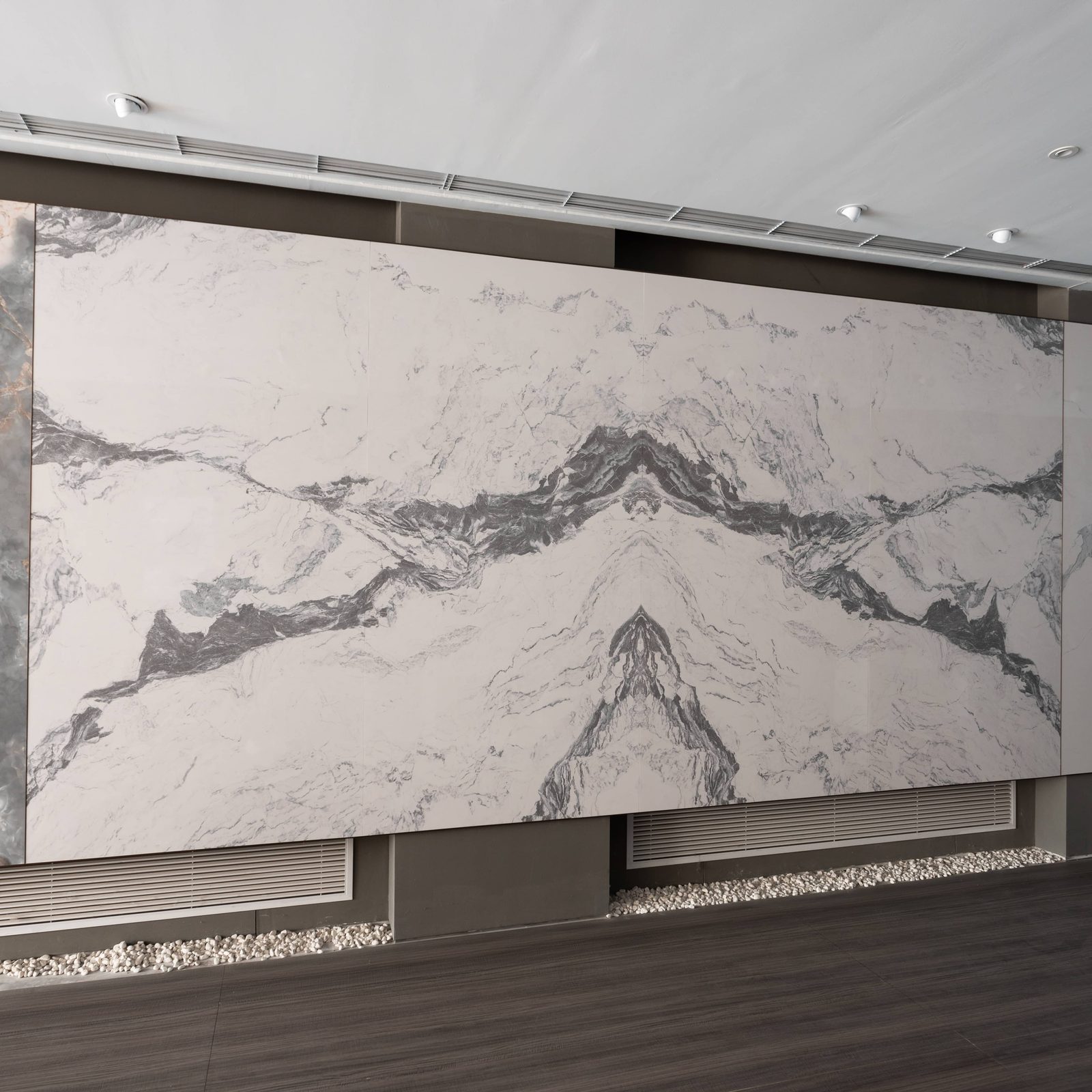
Radiused reception walls, round columns, bow-fronted counters: design keeps asking for a curve, and the frame is usually built before anyone checks whether the board will follow it. Whether a curved wall panel ends as a clean sweep or a cracked compromise is settled at specification and framing stage — not on site.
Why a Mineral Board Bends at All
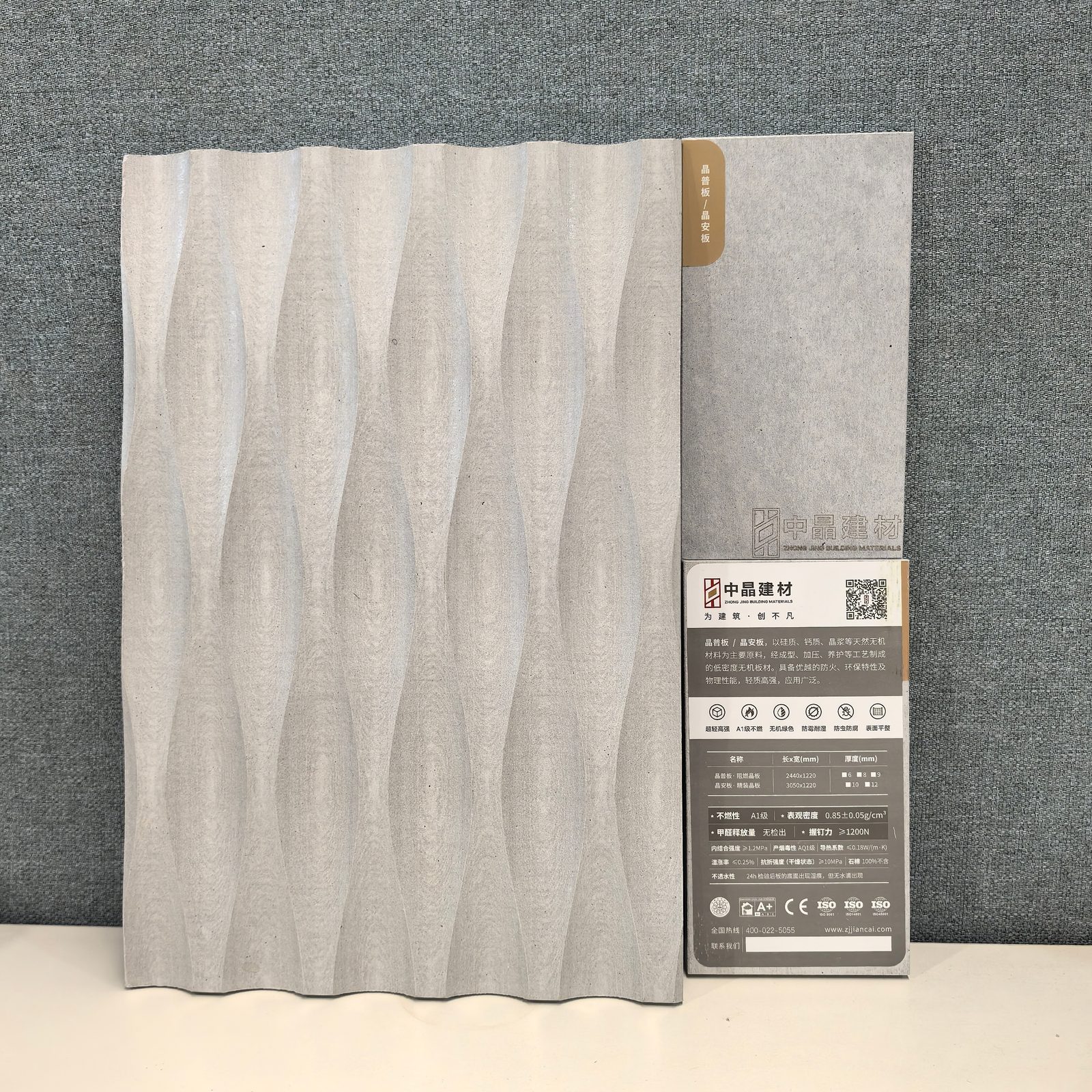
The sheet is cement, ground silica and cellulose fibre, cured under steam pressure. The fibre is what matters: it bridges micro-cracks so the panel deflects instead of snapping, which is why a fiber cement board at 0.65–0.85 g/cm³ and 10 MPa flexural strength can be drawn around a form.
It is mineral, not plastic: no elastic memory to spring it back, and no unlimited deformation — past its limit you get a crack, not a recovery.
Thickness Decides Everything
The first decision on a curved wall is not the product name, it is the thickness the radius can accept.
| Thickness | On a curved wall |
|---|---|
| 4–6 mm | Bends dry around a form; 6 mm is the bendable cement board we quote for curved work |
| 8 mm | Wide arcs only, and test it before cutting |
| 9–12 mm | Kerf the back face, facet it or segment it. Do not force it |
| 15 mm and above | The curve lives in the frame; the sheet sits on flats |
If it has to be 12 mm because the wall is also a fire barrier, the curve becomes a facet or a framed shape, and the drawing should say so before tender (thickness guide).
Test the Radius Before You Build the Frame
Radius cannot be read across batches: it moves with thickness, density, fibre content and moisture. Cut a sample from the batch actually delivered and bend it over a form of the design radius before the studs go up — tightest point, installed direction. The installation guide covers the fixing sequence around it.
Do not soak the board. Water does nothing to a cured cement matrix; it only leaves a wet sheet drying in place, with wet expansion of 0.25% or less and dry shrinkage of 0.15% or less pulling at your joints.
Two Ways to Make a Curve
Bend the sheet. On 6 mm, work from the middle of the arc outward and fix as you go while the sheet is held against the form. Fixing centres tighten as the radius closes, because between fixings the sheet is always trying to straighten.
Facet the curve. From 9 mm up, narrow flats stepped around the arc are a technique, not a compromise — and they give what a bent sheet cannot: crisp shadow lines that read as deliberate. Kerfing is the middle route, acceptable only where the kerf is hidden or closed by a trim, because a kerf is an open edge in a board that wicks.
Either way the panel is a calcium silicate board or a fiber cement board, and the cutting rules hold: score, snap, treat the edge (cutting guide).
Framing a Curve
The board can only be as true as the frame it is pulled onto: a wavy stud line makes a wavy panel line, and no jointing hides it.
- Tighten stud centres as the radius closes; the tighter the arc, the less span holds flat.
- Laminate two thin rails around a template instead of forcing one deep section into the bend.
- Set the curve out physically — a batten sprung between pins — not as a radius on a drawing.
- Add blocking where the arc meets a flat wall; that transition is the least supported part.
- Do not overdrive fixings. A sheet in a bend is pre-stressed, and a cratered head loses hold where load is highest.
Joints on a Curve
Where a joint lands matters more on an arc: it is a line the eye follows, and outdoors it is also a path for water.
- Put joints at the flattest part of the curve, or at a designed break such as a trim or reveal. Never at the crown.
- Size for movement, with a backer rod and a bond breaker: three-sided adhesion fails earlier on a curve, and fails invisibly.
- Keep the cavity drained. On an exterior curve the joint runs along the water, not off it, so the flashing behind does the work (facade cladding guide).
Finishing a Curved Face
Raking light travels along a curve, so every defect shows: the frame has to be right and the finish decided early. An uncoated board takes paint or a factory finish with no putty stage, which is why a curved Crystal Board wall is quicker than a skimmed one. A coated or printed sheet arrives finished — test an offcut at the real radius, because a film coating can craze. Screw heads and joints are the visible detail: choose shadow gap, trim or filled.
Where Not to Bend
- A tight radius on thick board. The crack along the crown that appears three weeks after handover.
- A convex exterior curve in a high-wind market. Suction over a curve differs from a flat wall, so fixings and cavity must be designed, not inherited.
- Where the curve takes impact. Corridors and schools want thickness and facets, not a 6 mm bend.
- A fire-rated assembly outside its tested build-up. The board stays A1 in any shape; the one-hour rating belongs to a system tested flat, so facet the curve or confirm it (partition guide).
- A permanently wet curve. A soffit that never dries wants a denser calcium silicate board.
What to put on the curved wall drawing
- Design radius, with the tightest point called out separately
- Thickness and density, and whether the curve is bent, kerfed or faceted
- Joint positions, with none at the crown
- Whether the wall is a fire barrier, and the tested system reference
A curve is not a harder wall, it is a wall with less tolerance: bend where the sheet can, facet where it cannot, and test the radius on the batch you were delivered.
Frequently Asked Questions
Can fiber cement board be bent into a curve?
Yes, in thin sections: a 6 mm fiber cement board bends dry around a form and can be fixed while held in the curve. From about 8 mm up, boards are kerfed, faceted or framed instead: a cured cement matrix does not stretch, and forcing it cracks.
What is the minimum bending radius for a cement board?
No single figure reads across batches. Radius moves with thickness, density, fibre content and moisture, so cut a sample from the delivered batch and bend it at the tightest radius on the drawing.
Does bending weaken a fiber cement board?
A controlled bend within the limit changes neither the fire classification nor the chemistry, and the frame holds the panel there. Damage comes from bending past the limit, creasing the face or kerfing through the fibre: a cracked sheet loses strength and water resistance on that line.
Can a printed or coated decorative board be curved?
Within its radius, yes, and the print stays with the sheet. Test an offcut at the real radius because a film coating may craze, and set the pattern direction out before cutting. Order spares from the same print batch.
Is a curved wall panel still fire rated?
Two questions. Reaction to fire is a material property: an A1 board to GB 8624 with AQ1 smoke toxicity stays A1 in any shape. A one-hour rating belongs to a tested assembly of board, frame and insulation, tested flat — for a curved barrier, confirm the system in writing.
The Bottom Line
Curved work with a mineral board is a sequence, not a trick: pick the thickness the radius can take, test that radius on the delivered batch, build a frame that is already true, decide where joints may fall, and choose the finish before boarding. Do those five and the curve looks drawn that way; skip them and no sealant rescues it. Where the shape is beyond the board, a faceted wall panel or a framed form reads better than a forced bend — and a bendable cement board is the wrong answer for a fire barrier or a wet zone, where a denser calcium silicate board belongs. Start with Crystal Board, the decorative board range or the full product family.